
Commercial Solar Panels
We are a team of solar PV technicians, designers and product developers who fully understand the green energy sector.
We clearly explain the benefits and potential return involved in installing commercial solar PV panels to generate renewable energy. We get to know you, your business, and your energy goals to design the best solar panel installation for your needs.
We manage the project from the initial conversations through to the post-installation aftercare to ensure that the project has been completed to your satisfaction and that you are benefiting in the way you had envisaged. With one point of contact at Solarcrown you will never be sent from pillar to post once work begins.
Accredited and approved by:




Why Solarcrown Commercial
One team, from first conversation to aftercare
Designed around your goals
We get to know you, your business and your energy goals first, then design the solar panel installation that fits your needs.
One point of contact
We manage the project from the first conversation through to post-installation aftercare, so you’re never sent from pillar to post once work begins.
Maintenance that protects output
Maintenance is critical to consistent output, so we offer solar PV maintenance packages tailored to suit your requirements.
What We Do
Our commercial solar panel services
Design and installation
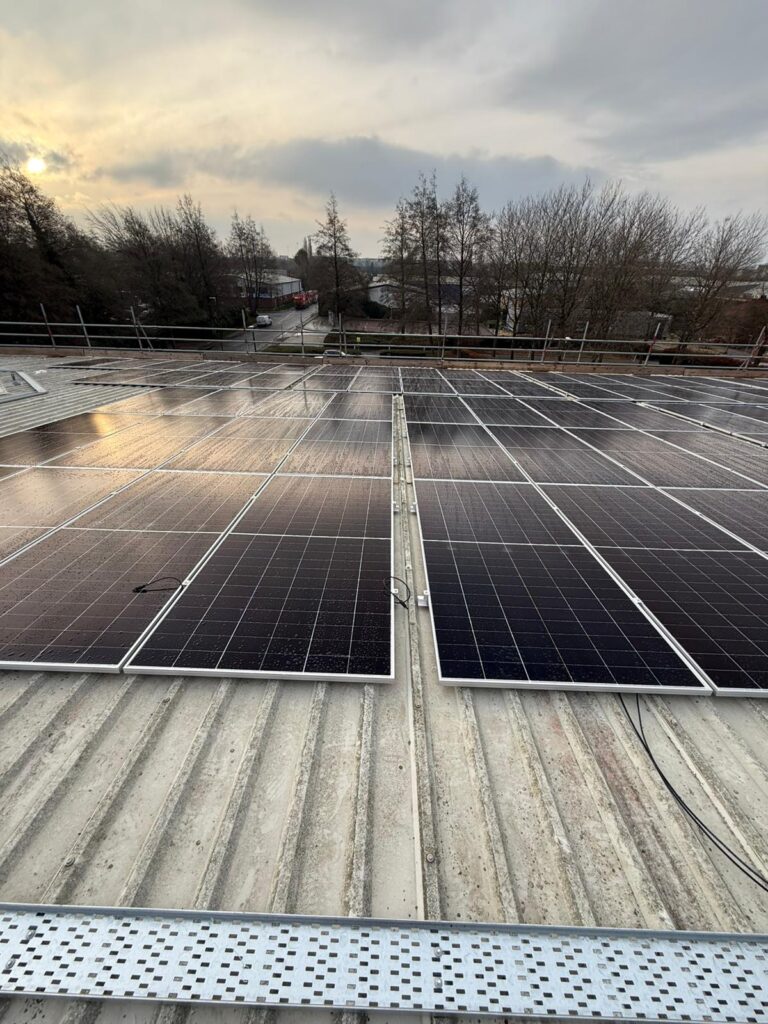
When it comes to choosing the right solar PV system for your business, it often comes down to size. Solar PV systems come in a range of sizes from just a couple of panels to a system that covers an entire roof. The choice of your PV system will be influenced by the amount of energy you use and therefore need, and how much space you have on the outside of your building to house the PV system.
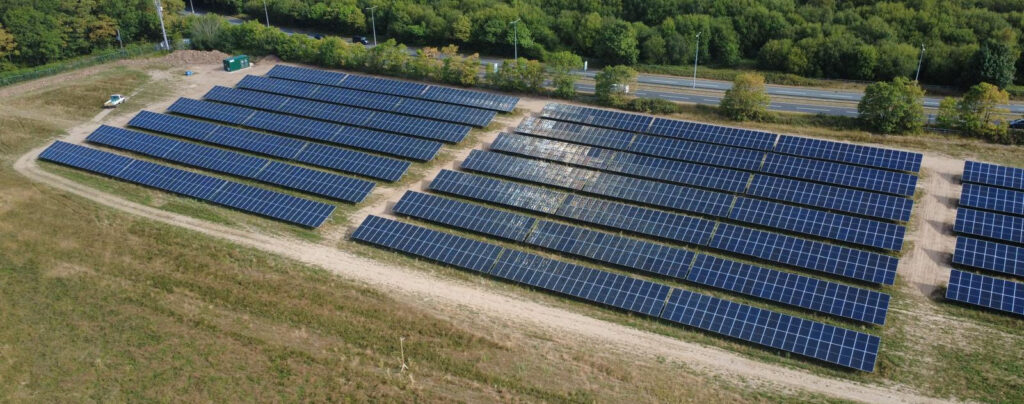
Most commercial roof systems don’t need specific planning permission; ground-mounted systems for large properties do.
ROI modelling
The sun doesn’t need to be shining for you to generate your own energy. Installation costs aren’t what they once were, and many commercial systems break even after only 4 years.
We will calculate your expected return on investment so you can make an informed decision.
~4 yrs
Typical break-even
~£2,000
saved a year by a 20kW system*
*Renewable Energy Hub, medium to large businesses.
Maintenance
Regular maintenance and cleaning of commercial solar PV systems are essential to keeping them running efficiently. Clean panels generate more energy, improve system performance and help extend the lifespan of the installation reducing the risk of costly repairs or replacements down the line.
Our solar PV maintenance contract provides you with a reliable and affordable way to ensure your business continues to get an optimal return on it’s investment.
Our maintenance contract is carried out by our own specialist engineers, a reliable, affordable way to protect your return.
Portfolio Management
Blue Sky Reporting
In a cost effective and step by step process we will review an entire property portfolio and present your roof top generation capability ranked from best to worse, your very own “Blue Sky” report. With this information in your hands you are on the first step to planning your possible independence from grid fed energy supplies. These valuable energy assets also represent an attractive environmental opportunity, with the ability to directly affect the carbon footprint of any operation.
A high-yield site can still be held back by:
- DNO (District Network Operator) and the lack of connection capacity
- Roof structure, and its ability to carry extra load
- Planning — do you need permission?
Illustrative example
What to expect
Typical project stages
Timescales vary by system size and site, but most commercial solar projects move through the same four stages.
2 - 6 weeks
Site assessment & planning
Structural surveys, shading analysis and grid connection approvals.
4 - 12 weeks
Permitting & approvals
DNO grid connection approval, plus planning permission where required.
2 - 6 weeks
Procurement & logistics
Ordering solar panels, inverters and mounting structures.
1 - 12 weeks
Installation & commissioning
Mounting, wiring, inverters and grid connection, then safety checks and performance testing.
Our work
Our commercial solar panel case studies



Customer story
See how we helped a UK business with their solar panel installation
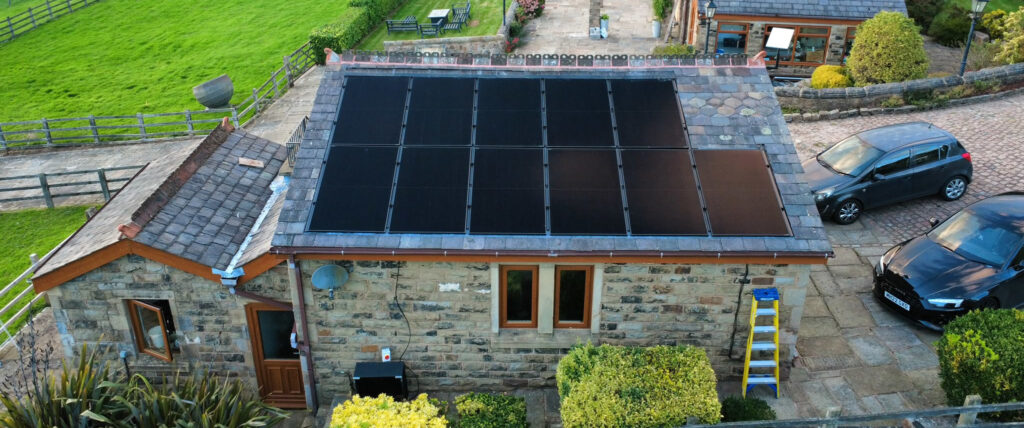
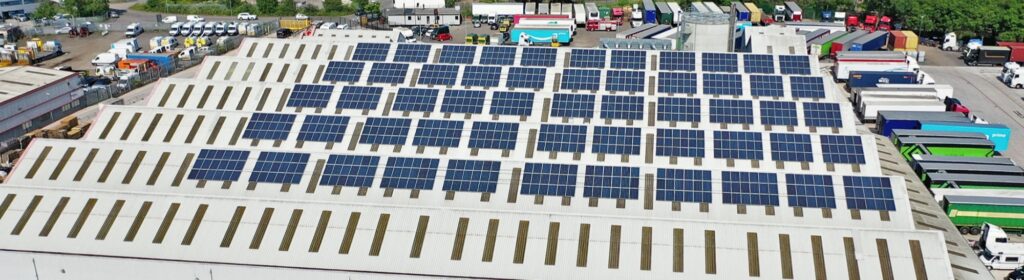
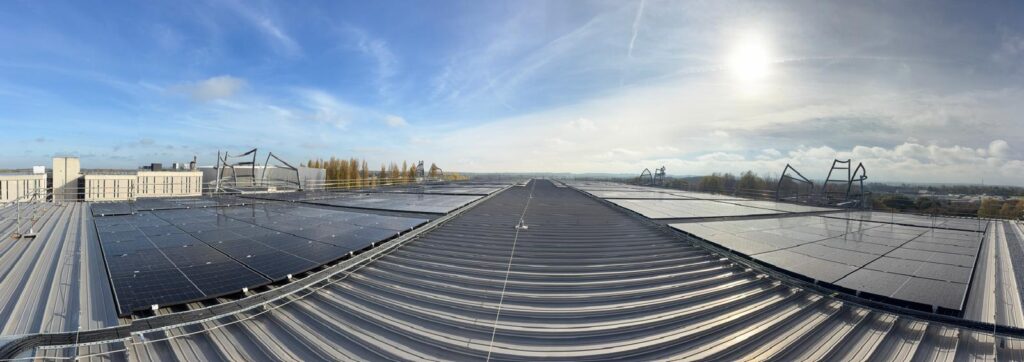
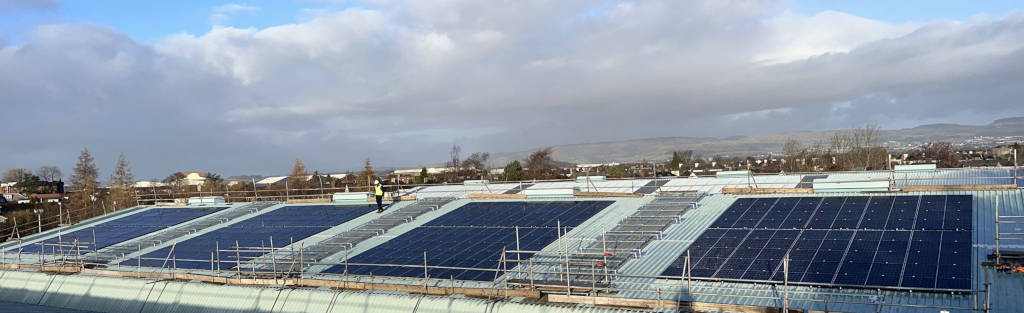
We designed and installed a 250kWp solar PV system, as part of a full electrical installation package, for Starbank Panel Products Ltd — a leading decorative panel fabricator committed to achieving net carbon zero. The installation spans five roofs.
Since moving to their redeveloped site, Starbank has also achieved a 36% improvement in electricity use per £1m of revenue, prompting them to come back to us to expand their solar capability.
250 kWp
solar PV across five roofs, with advanced electrical infrastructure
£38k → £50k+
annual returns, year one to recently — with £80k projected as energy prices climb
36%
improvement in electricity use per £1m of revenue
FAQs
Commercial solar installation FAQs
Straight answers to the questions we hear most from businesses considering solar.
How long does it take to install commercial solar panels?
The installation timeline for commercial solar panels varies depending on several factors, including the size of the system, roof complexity, weather conditions, and project approvals. However, here’s a general breakdown:
Typical Installation Timelines:
- Small commercial systems (up to 50kWp): 1–2 weeks
- Medium-sized systems (50–250kWp): 2–4 weeks
- Large commercial systems (250kWp–1MW+): 4–8 weeks
Factors That Affect Installation Time:
- Site Assessment & Planning (2–6 weeks)
- Structural surveys, shading analysis, and grid connection approvals.
- Permitting & Approvals (4–12 weeks)
- Grid connection approval from the Distribution Network Operator (DNO).
- Planning permission (if required, usually for ground-mounted or listed buildings).
- Procurement & Logistics (2–6 weeks)
- Ordering solar panels, inverters, and mounting structures.
- Installation & Commissioning (1–8 weeks)
- Mounting panels, wiring, inverters, and connecting to the grid.
- Safety checks and performance testing.
What is the overall efficiency of commercial solar installations?
The overall efficiency of commercial solar installations depends on several factors, including panel quality, system design, and environmental conditions. Here’s what to consider:
Solar Panel Efficiency:
- Standard commercial solar panels have efficiencies ranging from 18% to 22%.
- High-efficiency panels (e.g., monocrystalline or bifacial) can reach 22% to 24%.
- Lower-cost polycrystalline panels typically operate around 15% to 18%.
System Efficiency (Real-World Performance):
Beyond panel efficiency, the actual system efficiency accounts for energy losses in wiring, inverters, and other components. Typical figures include:
- DC to AC conversion loss (inverter efficiency): ~95%–98%.
- Cable and connection losses: 1%–3%.
- Dirt, dust, and shading losses: 2%–5%.
- Temperature losses (heat reduces panel performance): 3%–10%, depending on climate.
Overall System Performance (Performance Ratio – PR):
- The Performance Ratio (PR) of a well-designed commercial solar PV system typically ranges from 75% to 85%.
- This means that if a system is rated for 100kWp, it will typically produce 75-85kWh per 100kWh of ideal sunlight exposure.
Factors That Affect Efficiency:
- Panel orientation and tilt angle (optimal for maximum sun exposure).
- Shading from buildings, trees, or structures.
- Dirt and dust accumulation (regular maintenance improves efficiency).
- Temperature effects (cooler climates improve performance, as heat can reduce efficiency).
How much does it cost to install solar panels for commercial use?
The cost of a commercial solar PV system varies based on system size, equipment quality, site complexity, and installation requirements. Below is a general breakdown of factors affecting installation costs
- Larger systems reduce per-kWp costs but require higher upfront investment.
- Premium panels (monocrystalline, bifacial) cost more but deliver higher efficiency.
- String vs. microinverters impact costs and energy optimization.
- Roof type (flat, pitched, asbestos, metal) affects mounting costs.
- Structural upgrades may be needed for older buildings.
- Upgrades may be required if grid export limits apply.
- DNO approvals and potential planning permission for certain systems.
- Adds £250 – £500 per kWh of storage but increases energy independence.
Can my company take the tax benefit from installing commercial solar?
Companies can benefit from tax incentives when investing in commercial solar PV systems. There are several schemes available to help businesses reduce upfront costs and improve return on investment.
Capital Allowances
- Businesses can claim 100% of the cost of solar PV installations as a capital allowance.
- This applies under the Annual Investment Allowance (AIA), allowing companies to deduct the full cost of qualifying equipment from taxable profits in the year of purchase.
First-Year Allowance (FYA) – Full Expensing
- Since April 2023, Full Expensing (FE) allows companies to claim 100% of capital costs for solar PV systems in the first year.
- This replaces the previous Super Deduction, which expired in March 2023.
- Only limited companies that pay Corporation Tax qualify.
Enhanced Capital Allowances (ECA) for Energy-Saving Technology
- Some solar energy systems may qualify under the Energy Technology List (ETL).
- If eligible, businesses can write off 100% of the cost against taxable profits in the first year.
VAT Reduction
- Businesses pay 20% VAT on solar PV installations, but some exemptions apply for specific sectors like charities, non-profits, and social housing.
Smart Export Guarantee (SEG)
- Businesses can sell excess solar energy back to the grid and earn a tariff per kWh.
- Payments vary by energy provider, typically between 4p–15p per kWh.
Consult with a tax advisor to ensure eligibility and correct claims.
We offer a range of finance options for you to spread the cost of your LED lighting and solar PV technology.
Does my location affect the success of my solar panels?
Your location does play a role in the performance of your solar panels, but it’s rarely a barrier to success.
We assess every site individually, considering factors like roof orientation, pitch, shading, and local climate to ensure optimal system design. While southern-facing roofs tend to offer the highest yields, we successfully install systems across a wide range of building types and locations, including those in more shaded or northern areas by tailoring the system to the site’s conditions.
Our goal is to make solar viable and effective wherever your site is. With the right design and components, most UK locations can achieve strong performance and long-term savings.
We install solar panels nationwide, including Liverpool, Manchester, Cheshire, Lancashire, London, Birmingham, the North East and Scotland, and every project has been a success.
Learn More
Watch our commercial solar guides
By Sector
Solar PV for your sector
By Region
Installing nationwide
We assess every site individually, and we install solar panels across the UK, including: