
Energy Resilience Guide for Businesses
How to Reduce Risk, Control Costs and Improve Long-Term Performance
Why Energy Resilience Is Now a Business Priority
Energy resilience has moved from a technical consideration to a core business issue. Rising electricity prices, grid constraints and increasing pressure to meet carbon targets are forcing organisations to rethink how they manage energy.
Across the UK, electricity prices have seen significant volatility in recent years, with wholesale market fluctuations highlighted by Ofgem placing sustained pressure on operational budgets. At the same time, the National Energy System Operator has identified growing grid constraints and connection delays, particularly for high-demand sites.
Buildings remain a major part of the challenge. According to the Department for Energy Security and Net Zero, buildings account for around 30% of total UK energy use, with non-domestic buildings contributing significantly to emissions.
For estates teams, this has shifted the focus from simply consuming energy to actively managing it.
What Is Energy Resilience?
Energy resilience is the ability of a business to maintain operations, control costs and manage energy performance under changing conditions.
This includes reducing reliance on grid electricity, maintaining performance during disruption, improving visibility of energy usage and delivering predictable long-term costs.
In practice, resilient energy strategies are built around three components: on-site generation, demand reduction and performance monitoring.
1. On-Site Generation: Taking Control of Supply
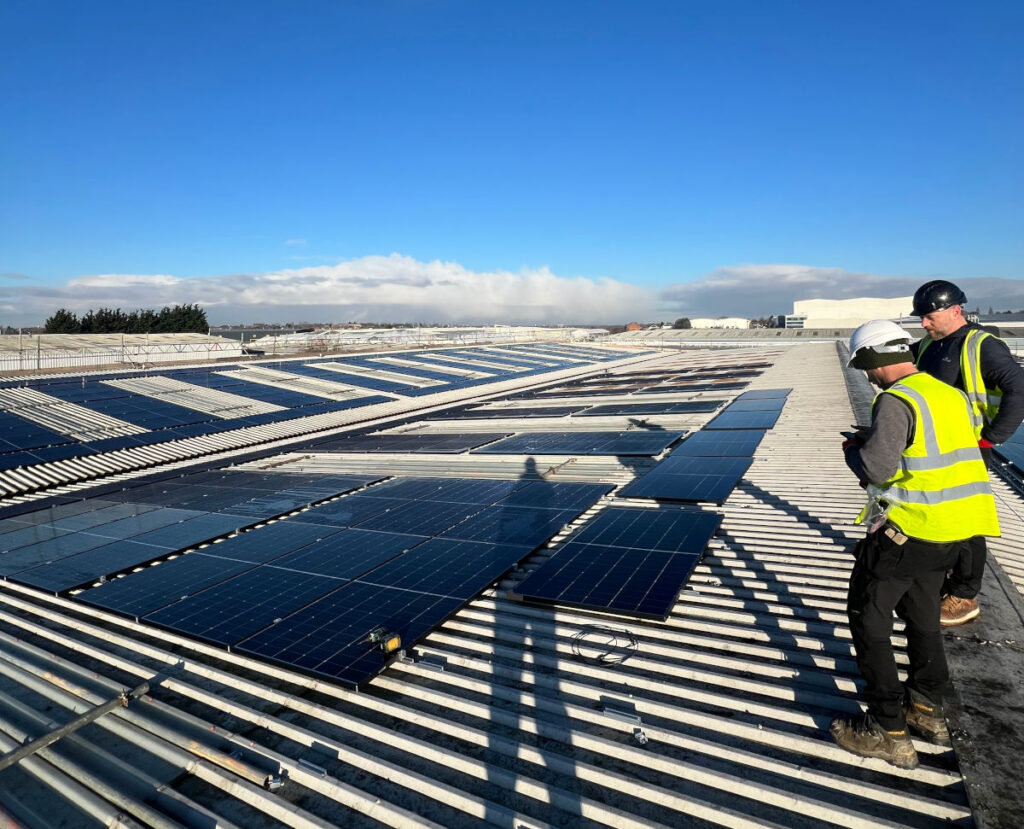
Generating energy at the point of use is the foundation of resilience. Solar PV allows businesses to produce electricity on-site, reducing exposure to grid supply and price volatility.
The importance of this approach is widely recognised. The International Energy Agency identifies distributed generation, including rooftop solar, as a key component of future energy systems and resilience strategies.
For many commercial buildings, solar can offset a significant proportion of daytime electricity demand, often in the range of 20–50%, depending on load profile and available roof space.
This is particularly effective in high-demand environments. For example, at a high-demand data centre in Manchester, we delivered a solar PV installation designed to align with the facility’s operational load. By generating electricity during peak daytime hours, the system reduces reliance on grid supply while supporting long-term cost control and carbon reduction.
Similarly, at a secure storage facility for the British Library, solar PV was deployed to support a highly controlled environment where reliability is critical. The installation provides a consistent source of renewable energy while reducing reliance on external supply.
These projects show how generation can play a direct role in improving operational resilience, particularly in buildings with predictable daytime demand.
2. Demand Reduction: Using Less Energy More Efficiently
Generating energy is only part of the equation. Reducing demand is equally important.
Lighting remains one of the largest energy loads across many estates. The Carbon Trust estimates that lighting can account for up to 40% of electricity use in commercial buildings, with LED upgrades capable of reducing this by as much as 80%.
In a turnkey hospital lighting project, we delivered a full intelligent lighting upgrade that achieved:
- 80% reduction in electricity consumption
- 240 tonnes of CO₂ saved in year one
- Return on investment in under four years
This type of upgrade not only reduces energy use but also improves compliance and reduces maintenance through longer product lifespans. By lowering overall demand, businesses can maximise the impact of solar generation and further reduce reliance on the grid.
3. Monitoring and Maintenance: Protecting Long-Term Performance
Energy resilience does not end at installation. Systems must continue to perform over time.
Research from the Building Research Establishment has consistently highlighted a gap between designed and actual building performance. Without proper monitoring, systems can underperform without being noticed, reducing both financial returns and carbon savings.
Even relatively small losses of 5–10% in system performance can have a significant financial impact over time.
At a social housing portfolio, we implemented a structured approach to managing existing solar assets, improving performance visibility and ensuring systems continued to operate as intended.
This highlights an often overlooked aspect of resilience: maintaining performance across the lifecycle of the asset, not just at installation.
The Role of Integration
One of the biggest barriers to energy resilience is fragmentation. Solar, lighting, controls and electrical systems are often treated as separate projects, delivered at different times by different providers.
Guidance from the Chartered Institution of Building Services Engineers emphasises the importance of coordinated system design to achieve optimal energy performance.
When generation, demand reduction and monitoring are integrated, they support each other:
- Solar reduces reliance on the grid
- Efficient lighting reduces demand
- Monitoring ensures both perform as expected
For businesses, this creates a more stable and predictable energy environment.
Scaling Across Estates
For organisations with multiple sites, resilience must be scalable.
Phased rollouts allow businesses to prioritise high-impact sites, standardise design and build a clearer picture of performance across the portfolio. This is particularly relevant for healthcare, education, industrial and commercial property sectors.
The Renewable Energy Association continues to highlight the role of commercial rooftop solar in supporting decentralised, resilient energy systems across the UK.
The Financial Case
Energy resilience is not just a sustainability initiative. It delivers measurable financial outcomes.
Typical benefits include reduced energy costs through on-site generation, lower maintenance costs, improved asset lifespan and protection against future price volatility.
Solar PV systems typically achieve payback within 3–6 years, with lifespans of 25 years or more. LED lighting upgrades often deliver faster returns, particularly in high-use environments.
When combined, these measures can significantly reduce operational expenditure over the long term.
Looking Ahead
The UK energy landscape is changing. Grid constraints, rising costs and regulatory pressure are unlikely to ease in the near term.
Businesses that rely entirely on external energy supply will face increasing exposure to these risks. Those that invest in on-site generation, efficient infrastructure and performance monitoring will be better positioned to maintain control.
Energy resilience is not a single project. It is an ongoing strategy that supports operational stability, cost control and sustainability performance.
Where to Start
For most organisations, the first step is understanding current performance.
This typically involves reviewing energy usage, assessing suitability for solar generation, identifying efficiency opportunities and evaluating existing system performance.
From there, a structured plan can be developed that balances cost, impact and operational requirements.