1.42 MW Solar Farm For A Community Business
2,274
Solar panels installed
1.42MW
Installed capacity
950kVA
Grid export
6,142.5m²
Array area
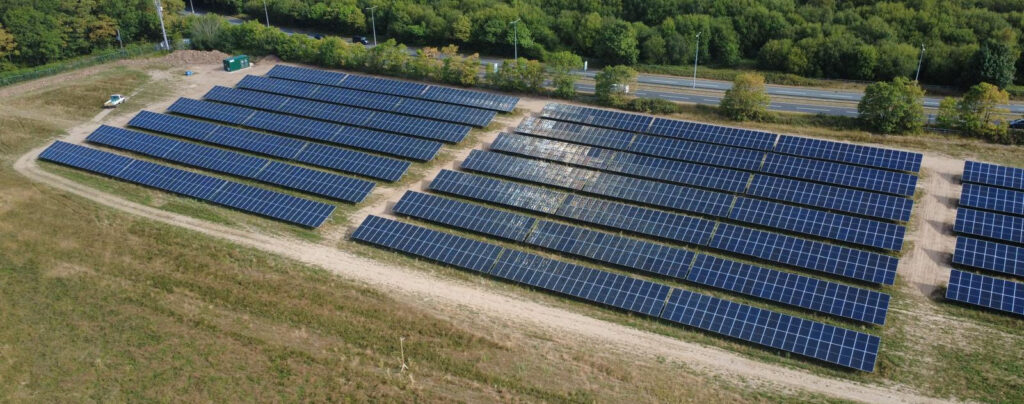
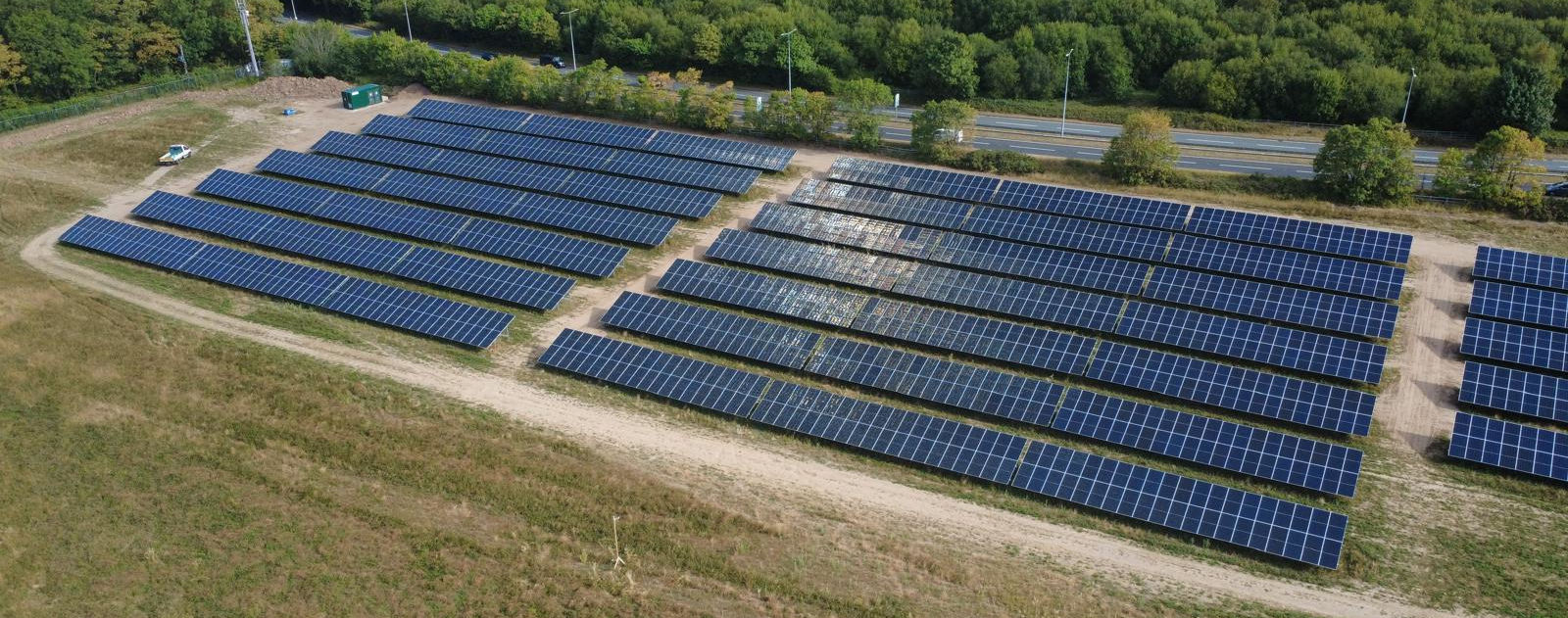
We delivered a 1.42 MW ground-mounted solar farm at Larkins Farm in Knowsley for Neighbourhood Services Company (NSC). The project has transformed part of the community farm into a renewable energy asset capable of exporting approximately 1.5 million kWh of electricity to the grid each year. As well as reducing carbon emissions, the income generated will help support the farm and NSC’s wider community services.
Solar Farm Project Overview
Larkins Farm is a 105-acre community site operated by NSC. Alongside its agricultural activities, the farm provides education, training, volunteering and therapeutic work placements for people from the surrounding area.
The solar farm has been developed on a parcel of Grade 3b agricultural land close to the farm’s main commercial hub. Its location, near the A580 and M57, provided practical access for construction and ongoing maintenance while allowing the land to continue supporting the farm’s wider activities.
NSC had already experienced the benefits of solar PV through systems installed by Solarcrown Commercial across several of its community buildings. Larkins Farm presented an opportunity to take this work further by developing a larger ground-mounted system that could generate renewable electricity for export to the grid.
Solarcrown Commercial supported the project from its early feasibility and business-modelling stages through to detailed design, planning, construction and grid connection.
Key Figures
- Installed capacity: 1,421.25 kWp
- Grid export capacity: 950 kVA
- Solar panels: 2,274
- Panel specification: 625 W Trina Solar modules
- Inverters: 19 Solis 50 kW inverters
- Solar array area: 6,142.5 m²
- Forecast grid export: 1,506,338 kWh per year
- Forecast first-year export: 1,503,359 kWh
- Forecast carbon reduction: 329,832 kg CO₂ per year
- Performance ratio: 84.5%
Generation and carbon figures are forecasts produced through PVSOL modelling. Actual performance will vary according to weather and operating conditions.*
Developing A Viable Solar Farm
The project began with a dedicated pre-construction phase covering the design and business modelling needed to establish whether the proposed solar farm was technically and financially viable.
This work examined the investment required, forecast export income, available grid capacity and the civil and electrical infrastructure needed to deliver the project.
Early studies considered a larger installation, but available grid capacity meant the project had to be adapted. The design was developed around a 950 kVA export connection, together with the site conditions and requirements of the Distribution Network Operator.
The final design comprised of a 1.421 MWp DC system using 2,274 high-output panels and 19 inverters. The array was modelled to achieve an annual yield of approximately 1,060 kWh for every kWp installed.
- Our pre-construction work included:
- Feasibility, investment and financial modelling
- Solar array design and generation forecasting
- High- and low-voltage electrical design
- Private network and grid-connection studies
- Civil works studies
- Panel and mounting-system layouts
- Inverter positioning and layouts
- DC and AC cable calculations
- Cable routes and containment layouts
- Site plans and equipment specifications
- Bill of materials
- Planning and supporting technical assessments
- DNO liaison and connection coordination
This detailed design work provided a clear technical and commercial basis for the construction phase and helped identify potential issues before work began on site.
Building The Business Case For A Solar Farm
A detailed business case was developed alongside the technical design to assess whether the solar farm could provide NSC with a sustainable long-term income.
The financial model included forecast operation and maintenance costs and the expected gradual reduction in panel output.
Even under a more cautious export-rate scenario, the modelling indicated that the solar farm could meet its finance and maintenance costs while creating a substantial long-term return.
The figures formed part of the project’s feasibility assessment and were based on the expected costs, export prices and funding assumptions available at the time.
Planning The Solar Farm Site
Delivering a solar farm involves significantly more than installing panels. The design and construction programme had to account for the site’s planning, environmental, drainage, access and archaeological requirements.
A flood-risk assessment confirmed that the development was in Flood Zone 1, where the annual probability of river flooding is below 0.1%. The assessment also found a low risk from surface water, groundwater and sewer flooding, concluding that the development could operate safely without increasing flood risk elsewhere.
Planning permission included measures intended to improve the site’s ecological value. The approved requirements targeted a minimum biodiversity net gain of 65.85% in habitat-area units and 70.03% in linear habitat units.
These measures include:
- New ecological and grassland management
- Species-rich wildflower meadow areas
- Enhancements to retained hedgerows and treelines
- Native planting
- Bird and bat boxes
- Insect habitats and refuge areas
- A two-metre-high living fence along the northern boundary
The living fence will provide site security while creating additional habitat around the perimeter. The ecological proposals can also maintain routes through the landscape for small mammals and other species.
Because solar panels are mounted above ground on posts, most of the land beneath and between the arrays will remain available for vegetation and complementary land uses. The environmental studies identified opportunities for conservation grazing or managed grassland beneath the installation.
Before and during the initial groundworks, archaeological fieldwalking, metal detecting and monitoring were also undertaken. This allowed construction to progress while protecting and recording any archaeological interest beneath the site.
Solar Farm Construction And Grid Connection
Construction began with site preparation, security fencing and the civil works required for the DNO connection, transformer and substation. A solar powered off-grid power supply was used to support site operations as there was no existing electrical infrastructure.
A dedicated substation and transformer area was created near the north-western corner of the site, close to the existing telecommunications mast. The associated infrastructure included high and low-voltage equipment, an 11 kV ring main unit, metering, cable routes and the systems required to connect the solar farm safely to the local network.
The grid design provided a 950 kVA export connection. It included new underground high-voltage cabling, connection into the existing network and the reinforcement work required by the DNO.
Once the mounting infrastructure was in place, installation moved on to the panels and electrical system. More than 2,000 modules were mounted across the site before being connected into strings. In parallel, work progressed on the inverter installation, switchgear, AC cabling and the route connecting the solar farm to the electricity network.
The connection phase included a dedicated DNO test trench, transformer station and final testing and commissioning. This infrastructure will allow the renewable electricity generated at Larkins Farm to be exported safely to the grid.
Solar Farm Long-term Performance
The project was designed with future operation and maintenance in mind. Equipment positioning, access tracks, cable routes and containment were all considered as part of the detailed design rather than addressed separately during construction.
Following commissioning, regular inspection and maintenance can include:
- Testing of the DC solar array
- Inspection of DC cable runs and labelling
- Inverter checks and testing
- Visual inspection of the panels and mounting system
- Performance checks and system recommissioning
- Scheduled panel cleaning
- Inspection of the high-voltage connection and associated equipment
- Management of the grassland and ecological areas
This planned approach will help maintain system performance, identify potential faults and protect the long-term value of the investment.
The development is also reversible at the end of its operational life. The panels, supporting framework, transformer and substation can be removed, allowing the land to be restored. The proposed living boundary and other established ecological improvements could be retained to continue supporting biodiversity.
Social And Financial Value
The completed solar farm is forecast to export approximately 1.5 GWh of renewable electricity during its first year and avoid around 330 tonnes of carbon emissions annually.
Unlike a conventional commercial solar installation, however, the benefits extend beyond energy generation. Revenue from exported electricity will provide a long-term income stream for Larkins Farm and support NSC’s work across the community.
The original business case demonstrated how the project could continue producing a positive return while meeting its finance and maintenance costs. Once the initial finance period has ended, a greater proportion of the export income could be directed towards the farm and NSC’s community activities.
The project also brings renewable energy technology into an active agricultural and educational environment. This will give visitors, trainees and volunteers an opportunity to see how farming, land management, biodiversity improvement and modern energy generation can operate alongside one another.