
A Guide to Installing Solar PV on Manufacturing and Production Plants
For UK manufacturing and production facilities, energy is no longer just an operational overhead, it’s a critical risk factor. With heavy machinery, automated production lines, continuous HVAC demands, and cold storage facilities operating around the clock, manufacturing plants feature some of the highest baseloads of any commercial sector.
Integrating a commercial solar photovoltaic (PV) system is one of the most effective structural interventions a manufacturer can make to protect margins, achieve energy independence, and satisfy stringent corporate ESG (Environmental, Social, and Governance) mandates.
This technical guide outlines the engineering, compliance, and financial considerations required to deploy solar PV on industrial production plants, drawing on real-world engineering insights from our projetcts.
Electrical Engineering & Profile Matching
The core financial viability of factory solar PV hinges on the Self-Consumption Rate (SCR). Unlike warehousing or logistics hubs, which often have low, intermittent power demands primarily driven by lighting, factories generally maintain a high, flat, or daytime-peaking energy profile.
High Daytime Baseload Alignment
Because manufacturing processes consume electricity simultaneously while solar panels generate it, factories naturally achieve an SCR close to 100%. Every kilowatt-hour (kWh) generated by the solar array is consumed instantly on-site, displacing expensive, variable-rate grid electricity.
Managing Inrush Currents and Power Quality
Industrial machinery (such as large motors, compressors, and CNC machines) causes substantial inrush currents (surge currents) when starting up.
- Inverter Selection: we utilise Tier-1 commercial smart inverters (e.g., SolarEdge or Huawei) equipped with advanced reactive power management.
- Harmonic Distortion & Voltage Stability: High-power industrial environments are prone to electrical noise and harmonic distortion. The design must ensure that the solar inverters integrate with the site’s existing Main Low Voltage (MLV) switchboard without degrading power quality or tripping sensitive automated production machinery.
Structural and Roof Engineering Considerations
Industrial factory roofs require rigorous structural assessment before any solar equipment can be deployed. Factory roofs typically fall into three categories: composite panels, built-up metal sheets, or flat roofs with single-ply membranes.
Structural Integrity & Point Loading
A standard commercial solar PV system adds approximately 10kg to 15kg per square meter for a flush-mounted pitched metal roof. If a flat roof layout requires a ballasted system to avoid structural penetrations, this load can jump to 30kg–50kg/m².
Structural Surveying
Before any installation, a Chartered Structural Engineer must calculate the dead load (the panels and mounting framework) and environmental live loads (wind uplift and snow loading) relative to the building’s portal frame capabilities.
Case Study Insight: Starbank Panel Products
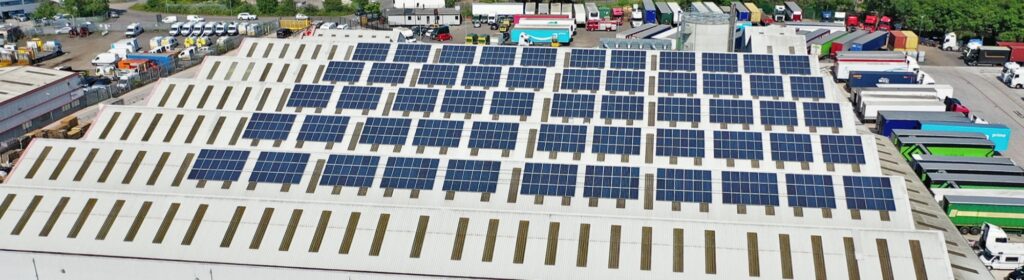
In our installation for Starbank Panel Products, a UK fabrication and manufacturing facility, structural optimisation was paramount.
We engineered and installed a massive 960-panel solar PV array across their manufacturing rooftop. By conducting detailed layout mapping, the system distributed the structural load evenly across the building’s purlins, ensuring the roof’s long-term integrity while yielding exceptional spatial efficiency to maximise energy output.
System Components and Technological Integration
To withstand the harsh environmental conditions occasionally generated by manufacturing emissions (such as particulates, chemical exhaust, or intense vibrations from internal machinery), the hardware specification must be strictly commercial-grade.
Tier-1 PV Modules
We deploy N-Type TOPCon or Mono-PERC half-cell modules from Tier-1 manufacturers. These modules offer:
- High Efficiency (21%+): Essential for maximising power generation per square meter of roof space.
- Low Degradation Rates: Ensuring the array still operates at ~85% efficiency after 25 years.
- Ammonia and Salt Mist Resistance: Critical for factories located in heavily industrialised zones or coastal environments.
Panel-Level Optimisation vs. String Inverters
In complex manufacturing layouts where roof vents, HVAC plant machinery, or extraction flues cast intermittent shadows, DC optimisation (such as SolarEdge technology) is highly advantageous. Individual panel optimisers prevent a single shaded module from bottlenecking the output of an entire string, while also offering panel-level monitoring and advanced safety features.
Regulatory Compliance, Grid Connection, and Safety
Deploying utility-scale generation assets on an active industrial site requires strict compliance with UK electrical and planning frameworks.
DNO Grid Connection (G99 Application)
Any solar PV installation exceeding 16A per phase requires formal approval from the local Distribution Network Operator (DNO) under Engineering Recommendation G99.
Because factories consume vast amounts of power, DNOs are generally favorable to these connections, as the power rarely exports back to the wider grid.
If the DNO imposes export limitations due to local grid constraints, we install export limitation systems or integrate battery storage solutions to capture excess generation.
Fire Safety and Rapid Shutdown
Industrial safety is paramount. Commercial systems should feature Rapid Shutdown or SafeDC™ capabilities. In the event of a grid outage or manual system de-energisation, the DC voltage across the roof is automatically stepped down to a safe level (1V per module), protecting emergency first responders and on-site maintenance teams.
Economic Performance Metrics and ROI
From a corporate finance perspective, solar PV is an asset class that converts an unavoidable operational expense (electricity bills) into a predictable, yielding capital asset.
- Payback Periods: For high-consuming manufacturing facilities, typical payback periods range between 3 to 5 years, depending on the current grid tariff and capital allowances.
- Capital Allowances (Full Expensing): UK manufacturing companies can leverage the government’s Full Expensing tax incentive, allowing them to claim a 100% first-year capital allowance on qualifying plant and machinery investments, including solar PV and commercial energy efficiency measures.
- Hedging Volatility: By generating up to 30–50% of a factory’s annual power on-site, a business significantly reduces its exposure to the volatile wholesale energy markets, introducing long-term price certainty into operational budgeting.
Partnering for Industrial Energy Transition
Transitioning a production plant to solar PV requires a partner capable of executing complex electrical engineering, managing strict health and safety protocols on an active production floor, and handling complex DNO negotiations.
The successful deployment of hundreds of kilowatts of clean energy, such as the 960-panel asset engineered for Starbank Panel Products, demonstrates that we possess the technical competence and commercial scale required to deliver high-yield industrial solar solutions.
To discover how a tailored solar PV array can stabilise your manufacturing facility’s operational margins and accelerate your net-zero timeline, explore our specialised engineering capabilities at Solarcrown Commercial Warehouses and Factories Sector.